
Confederate Generals Bios
“Stonewall” Jackson
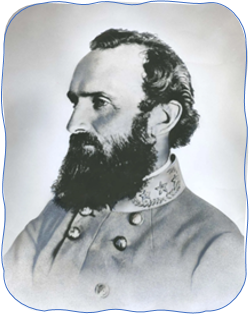
(Portrait of Stonewall Jackson, Fine Art America, 2013)
Significant Personal Events
- Thomas Jackson was born on January 21, 1824, in Clarksburg, Virginia 1
- Both Jackson’s parents died when he was three years old. One of his uncles took Jackson in and he lived with him until he was 16 years old2
- Jackson was recognized in his community as intelligent and was accepted into West Point at age 16. 3
- Jackson was a mediocre student at West Point, but worked extremely hard to achieve the grades he did. As a student, he did not socialize and was described as shy and hard-working.4
- Jackson graduated from West Point on July 1, 18465
- Jackson was married twice and had one child, a daughter, born after his death6
- Jackson was very religious and affiliated with the Presbyterian Church.7
- Jackson owned seven slaves before the Civil War began and believed it was a constitutional right to own them. Jackson fought to defend Virginia and promote the Confederate way of life.8
Significant Military Events:
- Jackson’s first military appointment was in the U.S. war against Mexico, where he was commended for his “gallant and meritorious conduct.”9
- In 1851, Jackson stepped down from military service due to some health issues and became a professor at Virginia Military Institute.10
- In April of 1861, Jackson joined the Confederate Army, was appointed Colonel of Volunteers and on May 3 ,1861 went Harpers Ferry to lead a command.11
- Jackson led the campaign of 1862 in the Shenandoah Valley, with the Confederacy seen as winning more tactical victories than the Union.12
- Jackson received the nickname “Stonewall” during the First Battle of Bull Run (Manassas), a major victory for the Confederate forces.13
- Jackson was accidentally shot by his own men during the Battle of Chancellorsville in Spotsylvania County, Virginia on May 2, 1863. His left arm was amputated and he subsequently developed pneumonia and died on May 10, 1863 at age 39. 14
Turner Ashby
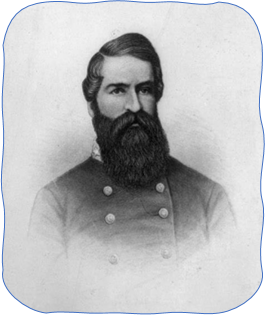
(Portrait of Turner Ashby, Library of Virginia, 1998)
Significant Personal Events
- Turner Ashby was born on October 23, 1828, in Fauquier County, Virginia.15
- His father, also named Turner Ashby, had fought as a colonel in the War of 1812, and his grandfather served as a captain during the Revolutionary War.16
- Ashby was interested in politics and ran for State Legislature but was not elected17
- He was found of horses since he was a boy and started his own Cavalry Company in in the 1850s.18
- Ashby owned seven slaves and believed in the institution of slavery.19
Significant Military Events
- After the raid on Harpers Ferry in 1859, Ashby and his calvary company any began patrolling the Shenandoah and Potomac rivers to guard against more raids from abolitionists. 20
- Ashby and his troop joined the Confederate military as part of the 7th Virginia Cavalry when the Civil War began, with Ashby as Captain.21
- In 1862, Stonewall Jackson appointed Ashby as commander of the cavalry for the Campaign of 1862. 22
- Ashby served under and supported Stonewall Jackson during the Campaign of 1862 in many major battles, providing information, participating in attacks and causing disruption and confusion to Union forces. 23
- Battle of Harrisonburg occurred on June 6, 1862. Ashby’s calvary tries to delay Union forces, and Ashby is shot and killed in the battle. 24
Robert E. Lee
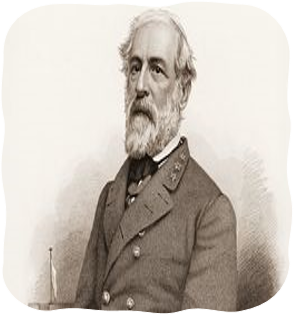
(Image of Robert E. Lee, Wall Street Journal, 2017)
Significant Personal Events
- Lee was born on January 19, 1807, in Stratford Hall, Virginia. 25
- He grew up rich with his father Henry Lee being a Revolutionary War hero.26
- Lee went to West Point, graduating second in his class in 1829.27
- Lee was deeply religious. He was married in 1831 and had seven children.28
- Lee had a stroke when he was 63 years old and died in 1870.29
- Lee owned slaves and defended it as an institution.30
Significant Military Events.
- Lee started off by serving in the United States Army as an engineer, helping build military bases.31
- Lee fought in the Mexican–American War in 1846 (1846–1848), receiving commendations for his performance on the battlefield.32
- Lee held superintendent of West Point for years before the Civil War.33
- After deciding to resign from the Army, Lee was appointed as commander of the Army of Northern Virginia, directing battles.34
- Lee was victorious in many battles throughout the war. He oversaw the Campaign of 1862 in the Shenandoah Valley, appointing Stonewall Jackson as commander.35
- John Esten Cooke, Stonewall Jackson: A Military Biography (D. Appleton and Company, 1876), 9. ↩︎
- Cooke, Stonewall Jackson: A Military Biography, 10. ↩︎
- Ibid. ↩︎
- Cooke, Stonewall Jackson: A Military Biography, 12-13 ↩︎
- Ibid. ↩︎
- Cooke, Stonewall Jackson: A Military Biography, 21 ↩︎
- Cooke, Stonewall Jackson: A Military Biography, 22. ↩︎
- Thomas Jackson Arnold, Early Life and Letters of General Thomas J. Jackson – “Stonewall” Jackson (Fleming H. Revell Company, 1916; reprint, Richmond: The Dietz Press, Inc., 1957), 266. ↩︎
- Cooke, Stonewall Jackson: A Military Biography, 15 ↩︎
- Cooke, Stonewall Jackson: A Military Biography, 19-20 ↩︎
- Cooke, Stonewall Jackson: A Military Biography, 35-37 ↩︎
- Cooke, Stonewall Jackson: A Military Biography, 39-53 ↩︎
- Addey Markinfield, Stonewall Jackson: The Life and Military Career of Thomas Jonathan Jackson (Scituate: Digital Scanning, Incorporated, 2001), 33. ↩︎
- M. Jackson, Life and Letters of General Thomas J. Jackson (Stonewall Jackson) (New York: Harper & Brothers, 1892), 471–74. ↩︎
- Thomas A. Ashby, Life of Turner Ashby (J. P. Bell Company, 1914),31 ↩︎
- William C. Weidner, “‘Poor Ashby Is Dead,’” America’s Civil War 18, no. 2 (May 1, 2005): 26–32, ↩︎
- Weidner, “‘Poor Ashby Is Dead,’” 28. ↩︎
- Ashby, Life of Turner Ashby, 38. ↩︎
- Ashby, Life of Turner Ashby, 44. ↩︎
- Weidner, “‘Poor Ashby Is Dead,’” 26. ↩︎
- Ibid. ↩︎
- Weidner, “‘Poor Ashby Is Dead,’” 27. ↩︎
- Weidner, “‘Poor Ashby Is Dead,’” 28-30. ↩︎
- Peter S. Carmichael, “Turner Ashby’s Appeal,” in Shenandoah Valley Campaign of 1862, ed. Gary W. Gallagher (University of North Carolina Press, 2003), 127. ↩︎
- Robert W. Winston, Robert E. Lee: A Biography (William Morrow & Company, 1934), 15. ↩︎
- Winston, Robert E. Lee: A Biography, 8-10 ↩︎
- Winston, Robert E. Lee: A Biography, 25-26 ↩︎
- Winston, Robert E. Lee: A Biography, 29 ↩︎
- Ibid. ↩︎
- Winston, Robert E. Lee: A Biography, 48-50. ↩︎
- Winston, Robert E. Lee: A Biography, 41-46 ↩︎
- Winston, Robert E. Lee: A Biography, 53-55 ↩︎
- Winston, Robert E. Lee: A Biography, 58 ↩︎
- Philip Katcher, The Army of Northern Virginia (Osprey Publishing, 2003), 20–21. ↩︎
- Katcher, The Army of Northern Virginia, 20–21. 91-109 ↩︎