
School Desegregation
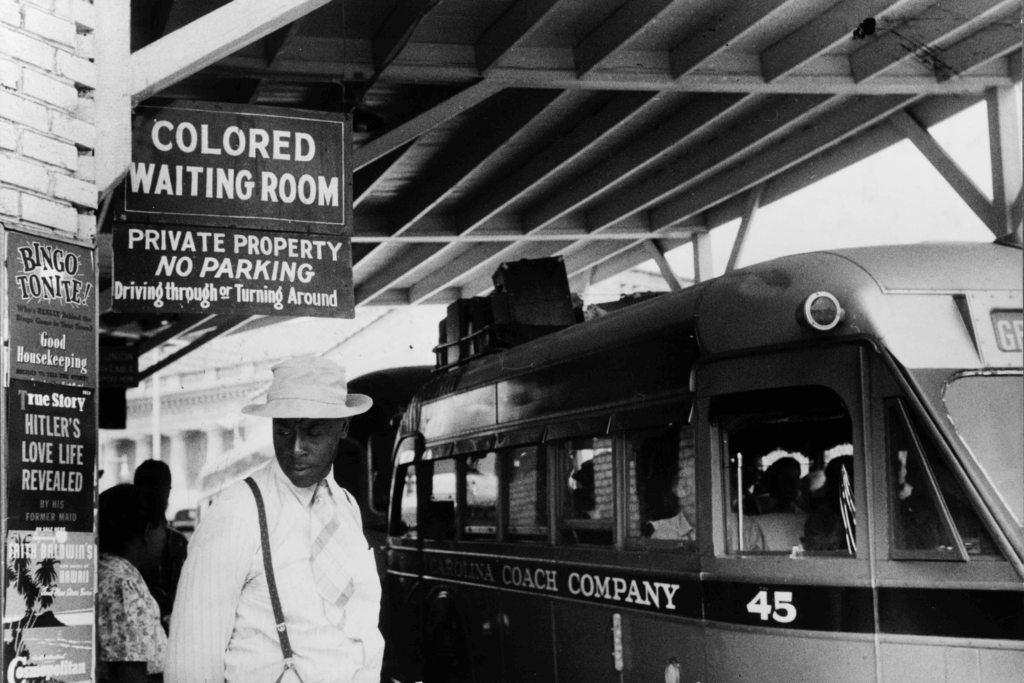
Plessy v. Ferguson (1890s)
The Louisiana General Assembly, enacted a law which stated “all railway companies carrying passengers in their coaches…shall provided equal but separate accommodations for the white and colored races.” Passengers who did not follow the law had to pay a $25 dollar fine and 25 days imprisonment. Homer Adolph Plessy with “one-eighth African ancestry” took a seat in the car reserved for whites. He was forcibly removed, charged and placed in jail. He was prosecuted in criminal court before Judge John H. Ferguson. Plessy argued that the law was unconstitutional. Ultimately, the case was appealed to the U.S. Supreme Court. The U.S. Supreme court rules on Plessy v. Furgeson. The main ruling was that “separate but equal” for public facilities. That phrase was not specifically noted in the decision, however. On the issue of racial segregation, the majority opinion did not believe that “social prejudice may be overcome by legislation,” stating “If the two races are to meet on terms of social equality, it must be the result of natural affinities, a mutual appreciation of each other’s merits and a voluntary consent of individuals.”1
Brown v. Board of Education of Topeka Kansas Decisions (1954)
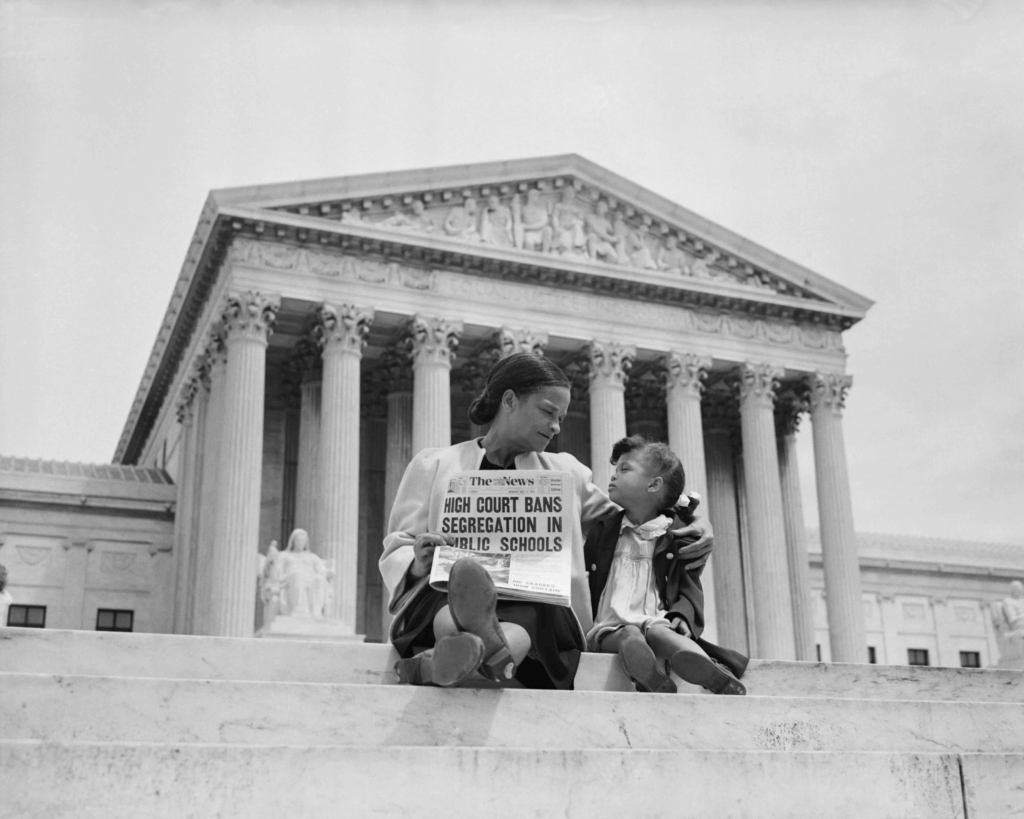
U.S. Supreme Court decided Brown v. Board of Education of Topeka Kansas, 347 U.S. 483 (1954). Brown was comprised of five appeals in different cases: Gebhart v. Belton (a case from Delaware), Brown v. Board of Education (a case from Kansas), Briggs v. Elliott (a case from South Carolina, Davis v. County School Board of Prince Edward County (a case from Virginia), and Bolling v. Sharpe (a case from the District of Columbia). All three cases related to whether it was unconstitutional to racially segregate public schools.2
The question before the court in Brown was whether segregation in public schools based on race deprives students equal protection of the law in violation of the Fourteenth Amendment. The Supreme Court unanimously decided that “separate but equal” was “inherently unequal” and violated the protections of the Equal Protection Clause of the Fourteenth Amendment. Chief Justice Earl Warren in the opinion stated that the segregation of public education based on race “generates a feeling of inferiority as to [African American] status in the community that may affect their hearts and minds in a way unlikely ever to be undone.”The Supreme Court said arguments would be heard during the next term to determine how the decision would be implemented. The Supreme Court in Brown v. Board of Education of Topeka, 394 U.S. 294 (1955) instructs states to take actions that are “necessary and proper” to desegregate public schools “with all deliberate speed.”3
The Supreme Court said arguments would be heard during the next term to determine how the decision would be implemented. The Supreme Court in Brown v. Board of Education of Topeka, 394 U.S. 294 (1955) instructs states to take actions that are “necessary and proper” to desegregate public schools “with all deliberate speed.”4
“Massive Resistance” (1956)
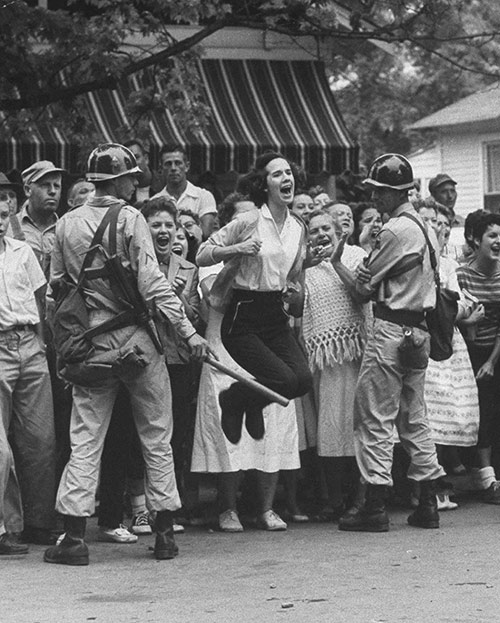
Led by conservative Democrat U.S. Sen. Robert Byrd, “Massive Resistance” begins, asserting that, in Brown, the federal government went too far and interfered with states’ rights; the South should resist. The “Southern Manifesto” was issued by southern legislators, including Senator Byrd. In this manifesto, the senators and congressmen asserted that Brown was an “abuse of judicial power” and “substituted “personal political and social ideas for the established law of the land.” The Stanley Plan was implemented in Virginia, enacting laws supporting the “Massive Resistance” policy. The laws included allowing the state to close schools that tried to integrate, stopping state funding for schools that allowed Blacks and whites to go to school together. Virginia Supreme Court declares the Stanley Plan unconstitutional. James v. Almond, 170 F. Supp. 331 (E.D. Va. 1959), held that the state was not permitted to avoid integration by closing public schools.5
- Plessy v. Ferguson, 163 U.S. 537 (1896). ↩︎
- Balkin, Jack M., ed. What Brown v. Board of Education Should Have Said: The Nation’s Top Legal Experts Rewrite America’s Landmark Civil Rights Decision. (New York University Press, 2001) ↩︎
- Brown v. Board of Education of Topeka, 347 U.S. 483 (1954). ↩︎
- Brown v. Board of Education of Topeka, 347 U.S. 483 (1954). ↩︎
- Robbins L. Gates, The Making of Massive Resistance: Virginia’s Politics of Public School Desegregation, 1954–1956 (University of North Carolina Press, 1964). ↩︎